Ask hollie
Ask hollie helps you investigate a specific question after responses arrive. Its answers stay within the response scope you choose and include citations to the supporting conversation evidence.
Choose the evidence scope
Ask from an individual response when you need that participant’s perspective, wording, or story. The launcher there is labelled Ask about this conversation.
Use Ask hollie from All Responses when you need to compare completed responses or look for a campaign-level pattern. Keep different analysis goals in separate saved conversations so their context does not become mixed.
Frame the analysis
State the decision or outcome you are investigating, the participants who matter, and any distinction hollie should compare. A precise scope produces a more useful answer than a broad request for everything important.
Continue in the same saved conversation when the next question depends on the previous answer. Start a new conversation when you change topic, audience, or decision.
Check the answer against its sources
Important claims appear with numbered citations and supporting quotes. Select a citation to open the response and transcript turn behind it.
Read enough of the surrounding exchange to confirm the meaning. A cited quote supports the point hollie made, but one quote does not prove that every participant agreed or that a pattern is representative.
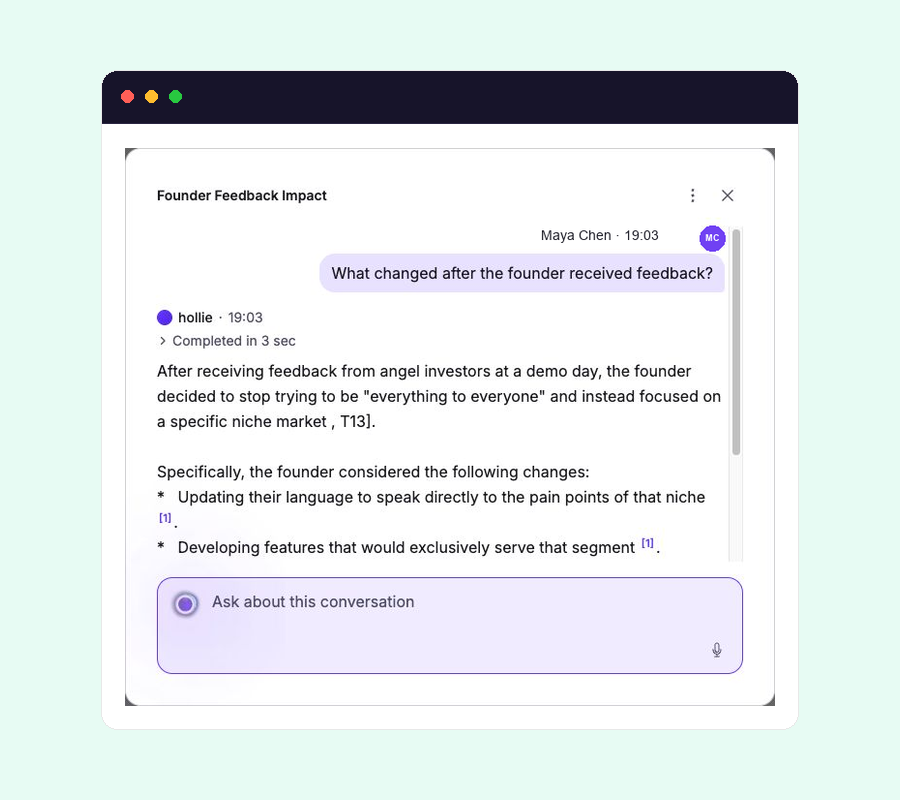
Continue or reopen analysis
Ask hollie conversations are saved and shared with your organisation team. You can return to a previous conversation to review its evidence or continue the analysis without rebuilding the context from the beginning.
When a new response changes the evidence available at campaign level, start by checking whether an earlier conclusion still holds. A saved answer records the analysis you ran at that time. It should not be treated as a permanently updating report.
Meaningful limits
Ask hollie needs completed response evidence. It cannot confirm facts that participants did not provide, and it should not be used to turn a small or self-selected response set into a statistically representative conclusion.
The citations show the strongest evidence used for an answer, not every relevant turn in the campaign. For high-stakes wording, read the original response and transcript before using the result.
See the full review and content workflow for the recommended order from evidence to output.