You open Search Console on a Monday. The clicks line, the one that has quietly fed your signups for two years, has a fresh cliff in it.
Not a dip. A step down. A whole shelf of traffic, gone over a weekend.
Then you realise which weekend it was.
June 24 to June 26. The Google June 2026 spam update. And you were not doing anything you thought counted as spam.
Here’s what this piece gives you: a way to tell what actually hit you, an audit of the patterns Google now punishes, and the one content moat a spam update can’t touch. No panic. No scrap-and-rebuild.
Let’s find out what fell off the cliff, and get it back.

What was Google’s June 2026 spam update?
Google’s June 2026 spam update rolled out from June 24 to June 26, 2026, taking about two days. It was the second spam update of the year, applied globally across every language, and targeted sites that break Google’s spam policies. Google says recovery can take many months, even after you fix the root problem.
That two-day window matters. It’s fast.
For contrast, the March 2026 spam update finished in under a day, the fastest on record. The August 2025 one ground on for nearly four weeks.
According to Search Engine Journal’s rollout coverage, the June update ran globally with no new spam policies attached. Google called it a normal spam update.
Nothing to see here.
Except the people watching their own graphs disagreed.
Barry Schwartz, who has tracked these rollouts for two decades, wrote that this one felt more widespread than a typical spam update. Site owners posting their damage reports this week describe the same thing: a healthy blog, no obvious sin, and organic visits collapsing from forty a day to a handful.
A “routine” update doesn’t feel routine when it’s your quarter.
A spam update improves the systems that catch policy violations, including SpamBrain. A core update re-weighs how all of search judges quality. Different machines, different fixes. Naming which one hit you is the first move.
Was it the spam update, the May core aftermath, or AI Overviews?
Before you touch a single page, diagnose the culprit. Three very different things are dragging blogs down right now, and each one wants a different response. Treat them as one problem and you’ll fix nothing.
Pull up Search Console. Isolate the date range. Then match your pattern to one of these three.
| Culprit | The tell | What it wants |
|---|---|---|
| June 2026 spam update | Rankings dropped inside the June 24 to 26 window, on specific pages | Audit against Google’s spam policies, fix or remove the offending pages |
| May 2026 core update aftermath | The step-down started in May and never came back | A quality rebuild across the whole site, not a spot fix |
| AI Overviews click erosion | Rankings held, but clicks fell while impressions stayed flat | Content that earns the click an AI answer can’t replace |
The May 2026 core update finished rolling out weeks before June’s spam pass, and plenty of sites never recovered from it. So if your cliff has two steps, you’re likely looking at both: a core-update wound that the spam update poured salt into.
The AI Overviews case is the sneaky one.
Your position holds. Your impressions look fine. But the click, the actual visit, gets eaten by an answer box before anyone reaches your page. That isn’t a penalty. That’s Google keeping the reader.
In Search Console, compare clicks and impressions side by side for the eight weeks around the drop. Clicks down with impressions flat means click erosion. Both down together means a ranking hit. The shapes tell you which fight you’re in.

Audit your site for the patterns Google now punishes
If the timing points at the spam update, the next question is the one everyone in the forums is asking this week: is publishing AI content still safe?
The honest answer: yes, and no.
Google does not penalise a page for being written with AI. It penalises the pattern AI made cheap. The spam policy names it directly: scaled content abuse, mass-producing low-value pages to game rankings rather than help a reader. The volume is the crime, not the tool.
So audit for the pattern, not the byline. Walk your library and flag:
- The scaled batch: dozens of near-identical posts spun from one template, published in a burst on the same day. The publishing pattern alone is a flag.
- The thin answer page: a 600-word post that restates the question and adds nothing a searcher couldn’t get from the first result. No experience, no data, no reason to exist.
- The empty programmatic set: hundreds of “[keyword] in [city]” pages built from a spreadsheet, with a swapped noun and nothing real inside.
- The unread archive: pages that get zero clicks and zero links, quietly dragging your whole domain’s quality signal down.
One community breakdown put it plainly: Google isn’t grading pages in isolation anymore, it’s grading the system that made them. If your content came off a factory line, the update can smell the factory.
Ripping out a hundred pages in a fury is how people turn a dip into a disaster. Cut only what’s genuinely thin and dead. Improve what has real intent behind it. Reckless pruning removes internal links and pages that were quietly helping.
Why is spam update recovery so slow?
Here’s the part nobody wants to hear.
Even if you fix everything today, you don’t get your traffic back on Friday.
Spam updates recover on Google’s clock, not yours. The systems have to re-crawl, re-assess, and wait for a periodic refresh before your cleanup counts for anything.
Search Engine Journal notes that improvements can take months for Google’s systems to reassess. A quick recovery isn’t the expectation, even for sites that make changes.
Barry Schwartz put it more bluntly: Google itself says it can take many months to recover.
That’s the real stake for a SaaS blog that drives signups.
A 60% traffic loss over a weekend isn’t a weekend problem. It’s a full quarter of pipeline, gone, with a reassessment window that laughs at your board deck. The sites still posting “any signs of recovery yet?” three months after a hit are not lazy. They’re stuck in the queue.
Waiting is not a strategy. Rebuilding is.
Which raises the only question that matters now: rebuild around what?
Rebuild the one moat Google can’t classify as spam
Every audit above removes risk. None of it creates an advantage. If your recovery plan is “delete the bad pages,” you end up smaller and just as replaceable.
The move is to build content on the one input a spam filter can’t fake or mass-produce: real first-hand experience.
Google spelled this out when it added a second E to E-A-T. The updated guidance on creating helpful, people-first content now asks whether a page shows genuine Experience: has the writer actually used the thing, sat in the room, felt the problem?
A model can imitate expertise. It cannot manufacture the specific, awkward, true detail of a real customer’s day.
That detail is the moat. And most of it is sitting in your customers’ heads, unwritten.
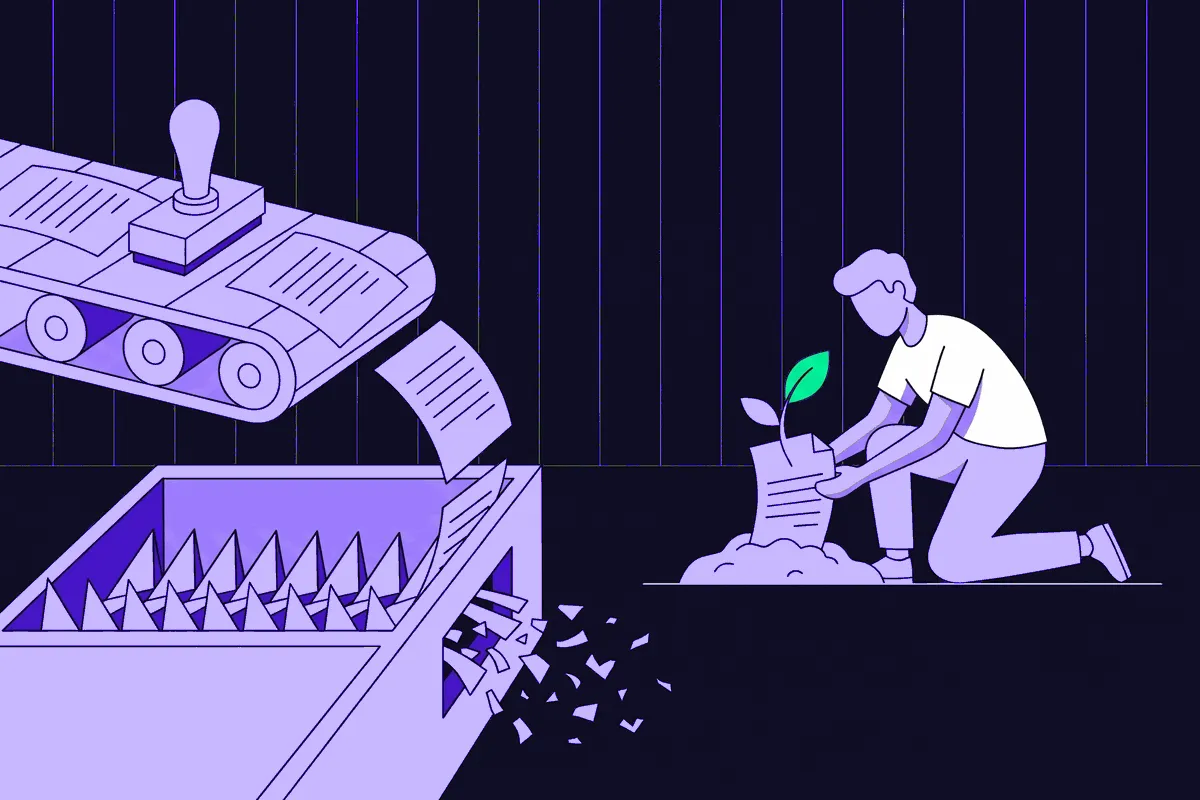
The blogs surviving this cadence aren’t the ones publishing faster. They’re the ones publishing what only they could know: the exact phrase a customer used to describe the problem, the objection that nearly killed the deal, the workaround they invented at 2am. That’s the raw material of a page a content farm can’t clone.
The catch is that gathering it the old way is slow. This is where real customer conversations change the maths. hollie goes and talks to your customers, then brings back their exact words and the why behind them, ranked. You write from what real people actually said, not from a prompt.
That’s content with fingerprints on it. Un-fakeable, un-scalable, and exactly what the update rewards.
Turn those conversations into your proof layer. Our guide on how to get customer case studies without the chase shows how, and you can build the ongoing habit with a simple system for collecting customer feedback.
If this whole “named update, mass confusion, no official recovery playbook” pattern feels familiar, it’s the same movie the ad world watched last year. The Meta Andromeda update playbook covers regaining control when a platform pulls the rug.
A model can copy your structure, your keywords, and your tone in seconds. It can’t copy the one customer story only you have. Build your library on first-hand experience and you build on ground the next spam update can’t wash away.
Frequently asked questions
How long does it take to recover from the June 2026 spam update?
Google says spam-related recovery can take many months, even when you fix the problem quickly. Your changes only count after Google re-crawls, re-assesses, and runs a periodic refresh of the spam systems. Expect a reassessment window measured in months, not days. There is no shortcut and no appeal.
Does AI-generated content trigger the spam update?
Not by itself. Google penalises scaled content abuse, mass-producing low-value pages to manipulate rankings, regardless of whether a human or a model wrote them. The problem is thin, unhelpful content published at volume. AI content grounded in real experience and genuine value is not the target.
Was it the spam update or the May 2026 core update that hit me?
Check when your drop started. A June 24 to 26 fall points at the spam update. A step-down that began in May and never recovered points at the May 2026 core update. Many sites got both, and the dates in Search Console tell you which.
My rankings held but clicks fell. What happened?
That is usually AI Overviews click erosion, not a penalty. Your page still ranks, but an AI answer box satisfies the searcher before they click through. The fix isn’t a spam cleanup, it’s content that gives a reader a reason to visit that a summary can’t replace.
The road back
Diagnose the real culprit. Cut only what’s truly dead. Then rebuild on what a machine can’t reproduce.
Audit. Fix. Fingerprint.
The Bottom Line
The update cadence isn’t slowing, and recovery is measured in months. Stop chasing the algorithm. Build the one asset it can’t classify as spam: content grounded in real customer experience. hollie can have those conversations and bring back the exact words your best pages need. Try holito.